Popular Posts

Tuesday, February 11, 2020

Good to Great, By Jim Collins


Related image
Page 21: "Level 5 leader - an individual who blends extreme personal humility with intense professional will."

Page 22: "Level 5 leaders are a study in duality: modest and willful, humble and fearless."

Page 25: "His placid persona hid an inner intensity, a dedication to making anything he touched the best it could possibly be -- not just because of what e would get, but because he simply couldn't imagine doing it any other way."

Page 30: "...Level 5 leadership is not just about humility and modesty. It is equally about ferocious resolve, an almost stoic determination one to make the company great."

Page 35: "Level 5 leaders look out the window to apportion credit to factors outside of themselves when things go well... At the same time, they look in the mirror to apportion responsibility never blaming bad luck when things go poorly."

Page 45: "...the idea that "who" questions come before "what questions -- before vision, before strategy, before tactics, before organizational structure, before technology."

Page 51: "The good-t-great companies placed greater weight on character attributes than on specific educational background, practical skills, specialized knowledge, or work experience."

Page 53: "..stealing precious time in their lives that they could use to move on to something else when in the end they aren't going to make it anyway - that would be ruthless. To deal with it right up front land lets people get on with their lives -- that is rigorous." 

Page 54: "If your growth rate in revenues consistently outpaces your growth rate in people, you simply will not -- indeed cannot -- build a company."

Page 56: "Strong performers are intrinsically motivated by performance, and when they see their efforts impeded by carrying extra weight, they eventually become frustrated."

Page 58: "First, if it were a hiring decision (rather than a "should this person get off the bus" decision, would you hire the person again? Second, if the person came to tell you that he or she is leaving to pursue an exciting new opportunity, would you feel terribly disappointed or secretly relieved?"

Page 69: "One of the dominant themes from our research is that breakthrough results come about by a series of good decisions, diligently executed and accumulated one on top of another."

Page 70: "...when you start with an honest and diligent effort to determine the truth of the situation, the right decisions often become self-evident."

Page 75: "...keep asking questions until he had a clear picture of reality and its implications. Why, why, why?... Furthermore, they used questions for one and only one reason: o gain understanding. They didn't use questions as a form of manipulation or as a way to blame or put down others. "Having the humility to grasp the fact that you do not yet understand enough to have the answers and then to ask the questions that will lead to the best possible insights."

Page 82: "...never had the gal to merely survive but to prevail in the end as a great company.'

Page 83: "...the management team responded with a powerful psychological duality. One the one hand, the stoically accepted the brutal facts of reality. On the other hand, they maintained an unwavering faith in the end game, and a commitment to prevail as a great company despite the brutal fact.s We came to call this duality the Stockdale Paradox."

Page 85: "You must never confuse faith that you will prevail in the end -- which ou cane ver afford to lose- with the discipline to confront the most brutal facts of your current reality, whatever they might be." "Life is unfair--- sometimes to our advantage, sometimes to our disadvantage. We will all experience disappointments and crushing events somewhere along the way, setbacks for which there is no "Reason," no one to blame... it is not the presence or absence of difficulty, but how they deal with the inevitable difficulties of life."

Page 87: "...the key elements of greatness are deceptively simple and straightforward. The good-to-great leaders were able to strip away so much noise and clutter and just focus on the few things that would have the greatest impact."

Page 91: "Foxes pursue many ends at the same time and see the world in all its complexity. They are "scattered or diffused, moving on many levels." Hedgehogs, on the other hand, simplify a complex world into a single organizing idea, a basic principle or concept that unifies and guides everything. It doesn't matter how complex the world, a hedgehog reduces all challenges and dilemmas to simple-- ideas. Anything that does not somehow relate to the hedgehog idea holds no relevance."  "No, hedgehogs aren't simpletons; they have a piercing insight that allows them to see through complexity and discern underlying patterns. Hedgehogs see what is essential, and ignore the rest."

Page 98: "The Hedgehog Concept is not a goal to be the best, a strategy to be the best, an intention to be the best, a plan to be the best. It is an understanding of what you can be the best at."

Page 122: ".. when you set your objectives for the year, you record them in concrete. You can change your plans through the year, but you never change what you measure yourself against. You are rigorous at the end of the year, adhering exactly to what you said was going to happen. YOu don't get a chance to editorialize....You never just focus on what you've accomplished for the year; you focus on what you've accomplished relative to exactly what you said you were going to accomplish.

Page 126: "...getting self-disciplined people on the bus in the first place. Next, we have disciplined thought. you need to discipline to confront the brutal facts of reality while retaining resolute faith that you can and will create a path to greatness. " "The point is to first get self-disciplined people who engage in very rigorous thinking, who then take disciplined action within the framework of a consistent system designed around the Hedgehog Concept."

Page 156: "Twenty percent of our success is the new technology that we embrace...eighty percent of our success is in the culture of our company."

page 160: "We're just never satisfied. We can be delighted, but never satisfied." "No, those who turn good into great are motivated by a deep creative urge and an inner compulsion for sheer unadulterated excellence for its own sake. Those who build and perpetuate mediocrity, in contrast, are motivated more by the fear of being left behind."

Page 161: "Those that stay true to these fundamentals and maintain their balance, even in times of great change and disruption, will accumulate the momentum that creates breakthrough momentum.

Page 165: "Good to great comes about by a cumulative process -stey by step, action by action, decision by decision, turn by turn of the flywheel - that adds up to sustained and spectacular results."

Page 173: "They key, is to harness the flywheel to manage these short-term pressures. "

Page 178: "When people,e begin to feel the magic of momentum -- when they begin to see tangible results and they can feel the flywheel beginning to build speed -- that's when the bulk of ppl line up to throw up their shoulders against the wheel and push. 
Page 195: "The point is not what core values you have, but that you have core values at all, that you know what they are, that you build them explicitly into the organization, and that you preserve them over time." "...a classic case of preserving the core and stimulate progress, holding a core ideology fixed while changing strategies and practices over time, and its adherence to this principle is the fundamental reason why it has endured as a great company." 
Page 205: "There is great solace in the simple fact of clarity - about what is vital, and what is not." 
Page 208: "...those who strive to turn good into great find the process no more painful or exhausting than those who settle or just lettings things wallow along in mind-numbing mediocrity. Yes, turning good into great takes energy, but the building of momentum adds more energy back into the pool than it takes out." 
Page 209: "Get involved in something that you care so much about what you want to make it the greatest it can possibly be, not because of what you will get, but just because it can be done." 


Saturday, January 12, 2019

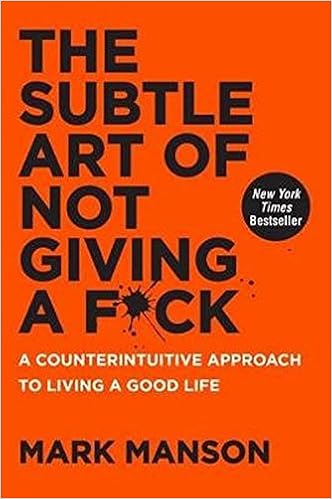
The Subtle Art of Not Giving a F*ck, By Mark Manson

Image result for the subtle ar


Page 8: "...accepting that the world is totally fucked and that's all right, because it's always been that way, and always will be."

Page 11: "Being open with your insecurities paradoxically makes you more confident and charismatic around others (the backwards law)." "If you're able to not give a fuck about the pain, you are unstoppable."

Page 14: "Not giving a fuck does not mean being indifferent; it means being comfortable with being different."

Page 18: "If you find yourself consistently giving too many fucks about trivial shit that bothers you -- chances are you don't have much going on in your life to give a legitimate fuck about."

Page 19: "Maturity is what happens when one learns to only give a fuck about what's truly fuckworthy."

Page 27: "[Suffering] is nature's preferred agent for inspiring change.. it's the mildly dissatisfied and insecure creature that's going to do the most work to innovate and survive."

Page 31: "The secret sauce is in the solving of the problems, not in not having problems in the first place."

Page 34: "Just because something feels good doesn't mean it is good. Just because something feels bad doesn't mean it is bad. Emotions are merely signposts, suggestions... not commandments."

Page 35: "Decision-making based on emotional intuition, without the aid of reason to keep it in line, pretty much always sucks. You know who bases their entire lives on their emotions? Three-year-old kids. And dogs. You know what else three-year-olds and dogs do? Shit on the carpet."

Page 37: "Real, serious, lifelong fulfillment and meaning have to be earned through the choosing and managing of our struggles."

Page 56: "It takes just as much energy and delusional self-aggrandizement to maintain the belief that one has insurmountable problems as that one has problems at all." "Often it is this realization -- that you and your problems are actually not privileged in their severity or pain -- that is the first and more important step toward solving them."

Page 57: "The more freedom we're given to express ourselves, the more we want to be free of having to deal with anyone who may disagree with us or upset us."

Page 61: "... people become amazing because they're obsessed with improvement."

The more you question your own thoughts and perceptions, the stronger you believe in it when it has passed the questioning. 

Page 62: "And the knowledge and acceptance of your own mundane existence will actually free you to accomplish what you truly wish to accomplish, without judgment or lofty expectations."

Page 79: "If you want to change how you see your problems, you have to change what you value and/or how you measure failure/success."

Page 85: "'One day, in retrospect, the years of struggle will strike you as the most beautiful.'"

Healthy values are achieved internally - and are in your own control 

Page 87: "What are the values that you prioritize above everything else, and that therefore influence your decision-making more than anything else?"

Page 96: "With great responsibility comes great power."

Page 98: "We are responsible for experiences that aren't our fault all the time. This is part of life."

Page 99: "Nobody is ever responsible for your situation but you."

Page 101: "...if the people in your relationships are selfish and doing hurtful things, it's likely you are too, you just don't realize it."

Page 109: "We all get dealt cards. Some of us get better cards than others. And while it's easy to get hung up on our cards, and feel we got screwed over, the real game lies in the choices we make with those cards, the risks we decide to take, and the consequences we choose to live with. People who consistently make the best choices in the situations they're given are the ones who eventually come out ahead in poker, just as in life. And it's not necessarily the people with the best cards."

Page 114: "As you reassess your values, you will be met with internal and external resistance along the way."

When you look back and notice differences in perspectives and notice flaws, that means you've grown.

Page 119: "Certainty is the enemy of growth."

Page 129: "The more we admit we do not know, the more opportunities we gain to learn."

Pae 130: "There is a certain comfort that comes with knowing how you fit in the world. Anything that shakes up that comfort -- even if it could potentially make your life better -- is inherently scary."

Page 133: "I say don't find yourself... Because that's what keeps you striving and discovering. And it forces you to remain humble in your judgments and accepting of the differences in others."

Page 140: "...if it feels like it's you versus the world, chances are it's really just you versus yourself."

Page 154: "Don't just sit there. Do something. The answers will follow."

Page 166: "Honesty is a natural human craving. But part of having honesty in our lives is becoming comfortable with saying and hearing the word "no." In this way, rejection actually makes our relationships better and our emotional lives healthier."

Page 174: "Acts of love (and kindness) are valid only if they're performed without conditions or expectations."

Page 193: "We're all driven by fear to give way too many fucks about something, because giving a fuck about something is the only thing that distracts us from the reality and inevitability of our own death."

Page 199: "Confronting the reality of our own mortality is important because it obliterates all the crappy, fragile, superficial values in life."


Sunday, December 30, 2018

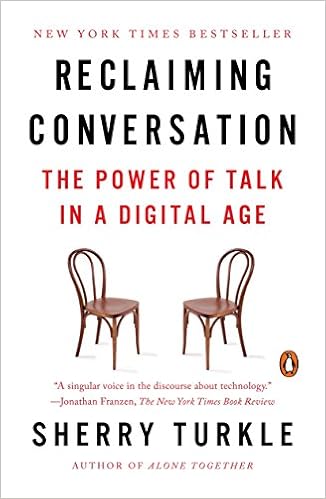
Reclaiming Conversation, By Sherry Turkle

Image result for reclaiming conversation


Page 4: "...we have become accustomed to a constant feed of connection, information, and entertainment."

Page 7: "Mobile technology is here to stay... We can both redesign technology and change how we bring it into our lives."

Page 9: "I hear a desire for distraction, comfort, and efficiency."

Page 10: "Solitude reinforces a secure sense of self, and with that, the capacity for empathy."

Page 16: "...we now rarely give each other ou full attention... we forget how unusual this has become, that many young people are growing up without ever having experienced unbroken conversations...phones have always come along."

Page 17: "We have learned that we get a neurochemical high from connecting. We recognize that we crave a feeling of being 'always on' that keeps us from doing our best, being our best."

Page 23: "If we are unable to be alone, we will be more lonely."

Page 24: "Research tells us that being comfortable with our vulnerabilities is central to our happiness, our creativity, and even our productivity."

Page 32: "If you are the penitent, you are called upon to put yourself in someone else's shoes. And if you are the person receiving the apology, you, too, are asked to see things from he other side so that you can move toward empathy. In a digital connection, you can sidestep all of this."

Page 36: "In conversations that could potentially take unexpected directions, people don't always try to get things 'right.' They learn to be surprised by the things they say. And to enjoy that experience."

Page 38: "We don't live in a silent world of no talk. But we drop in and out of talk we have...When talk becomes difficult or when talk turns to quiet, we've given ourselves permission to go elsewhere. To avoid life's challenges and boring bits."

Page 53: "But who said that a life without conflict, without being reminded of past mistakes, past pain, or one where you can avoid rubbing shoulders with troublesome people, is good?"

Page 56: "When we allow ourselves to be vulnerable and less in control, our relationships, creativity, and productivity thrive."

Page 60: "But because we don't want to be sad, we push it away with our phones. So you never feel completely happy or completely sad. You just feel kind of satisfied with your products. And then... you die."

Page 61: "It's the capacity of solitude that allows you to reach out to others and see them as separate and independent. You don't need them to be anything other than who they are. This means you can listen to them and hear what they have to say... If you are comfortable with yourself, you can put yourself in someone else's place."

Page 65: "Solitude- the capacity to be contentedly and constructively alone."

Page 107: "Relationships deepen not because we necessarily say anything in particular but because we are invested enough to show up for another conversation... learn that what can matter most is not the information shared but the relationships sustained."

Page 125: "We become accustomed to seeing life as something we can pause in order to document it, get another thread running in it, or hook it up to another feed. We've seen that in all of this activity, we no long experience interruptions as disruptions. We experience them as connection. We seek them out, and when they're not there, we create them."

Page 169: "I want people to live in the moment for friendship. Don't come with your history or expectations. You should be able to start your relationship from where you are now."

Page 173: "Empathy means staying long enough for someone to believe that you want to know how they feel, not that you want to tell them what you would in their circumstance. Empathy requires time and emotional discipline."

Page 184: "And they were both committed to making it work, so they took the time to get to know each other.. Now, you are on your own. And if someone finds a fault in you, you're off the list. Next."

Page 196: "But getting to know other people, appreciating them, is not necessarily a task enhanced by efficiency. This is because people don't reveal themselves, deeply, in efficient ways. Things take time to unfold. There is a need for backtracking and repetition. There is a deepening of understanding when you have gone through the same thing twice, or more."

Page 220: "Having access to information is always wonderful, but without having at least some information retained in my brain, I am not able to build on those ideas or connect them together to form new ones."

Page 244: "But the value of what you produce, what you "make," in college is not just the final paper; it's the process of making it."

Page 245: "Most insist that they will know when they have to schedule a face-to-face meeting. They will know if something comes up that they can't take care of over Gchat. But my experience is that you really don't know when you are going to have an important conversation."

Page 274: "Now, the screens on our phones and laptops keep us apart, or at best, alone together, physically in the same space but isolated, with our minds on our devices."

Page 284: "We are called to be more intentional about the use of technology and the value of conversation."

Page 307: "The web promises to make our world bigger. But as it works now, it also narrows our exposure to ideas. We can end up in a bubble in which we hear only the ideas we already know. Or already like." "The most successful tyranny is not the one that uses force to assure uniformity, but the one that removes awareness of other possibilities."

Page 321: "Unitasking is key to productivity and creativity, Conversation is a human way to practice unitasking."

Page 326: "We can use our technology, all of our technology, with greater intention. We can practice getting closer to ourselves and other people."

Page 333: "He uses a public conversation to keep him open to changing his mind."

Page 347: "...learn that you can attach to people with trust, make some mistakes, and risk open conversations...talks with the inanimate (robots) are taking her in another direction: to a world without risk and without caring."

Page 361: "When people give themselves the time for self-reflection, they come to a deeper regard for what they can offer others."

Page 362: "...remember who we are -- creatures of history, of deep psychology, of complex relationships. Of conversations artless, risky, and face-to-face."

Sunday, April 1, 2018

How to Win Friends & Influence People, By Dale Carnegie


Page 24: "Remember that the use of these principles can be made habitual only by a constant and vigorous campaign of review and application. There is no other way."

Page 25: "Hesitate about doing the natural thing, the impulsive thing."

Page 5:" Ninety-nine times out of a hundred, people don't criticize themselves for anything, no matter how wrong it may be. Criticism is futile because it puts a person on the defensive and usually makes him strive to justify himself."

Page 9: "Lincoln replied, 'Don't criticize them; they are just what we would be under similar circumstances.'"

Page 13: "When dealing with people, let us remember we are not dealing with creatures of logic. We are dealing with creatures of emotion, creatures bristling with prejudices and motivated by pride and vanity."

Page 16: "Instead of condemning people, let's try to understand them. Let's try to figure out why they do what they do. That's a lot more profitable and intriguing than criticism; and it breeds sympathy, tolerance and kindness,"

Page 17: "Dr. Dewey said that the deepest urge in human nature is 'the desire to be important.'"

Page 23: "The best way to develop the best that is in a person is by appreciation and encouragement."

Page 28: "Try leaving a friendly trail of little sparks of gratitude on your daily trips. You will be surprised how they will set small flames of friendship that will be rose beacons on your next visit."

Page 42: "The world is full of people who are grabbing and self-seeking. So the rare individual who unselfishly tries to serve others has an enormous advantage. He has little competition." "People who can put themselves in the place of other people, who can understand the workings of their minds, need never worry about what the future has in store for them."

Page 52: "You can make more friends in two months by becoming genuinely interested in other people than you can in two years by trying to get other people interested in you."

Page 57: "One can win the attention and time and cooperation of even the most sought-after people by becoming genuinely interested in them."

Page 67: "Action seems to follow feeling, but really action and feeling go together: and by regulating the action, which is under the more direct control of the will, we can indirectly regulate the feeling..." "Everybody in the world is seeking happiness - and there is one sure way to find it. That is by controlling your thoughts. Happiness doesn't depend on outward conditions. It depends on inner conditions." "It isn't what you have or who you are or where you are or what you are doing that makes you happy or unhappy. It is what you think about it.. different mental attitudes."

Page 69: "Drink in the sunshine; greet your friends with a smile, and put soul into every handsclap. Do not fear being misunderstood and do not waste a minute thinking about your enemies. Try to fix firmly in your mind what you would like to do; and then,...you will move straight to the goal." "Picture in your mind the able, earnest, useful person you desire to be, and the thought you hold is hourly transforming you into that particular individual... Thought is supreme. Preserve a right mental attitude - the attitude of courage, frankness, and good cheer."

Page 73: "He knew how to handle people, and that is what made him rich."

Page 95: "The deepest principle in human nature is the craving to be appreciated."

Page 98: "The unvarnished truth is that almost all the people you meet feel themselves superior to you in some way, and a sure way to their hearts is to let them realize in some subtle way that you recognize their importance, and recognize it sincerely."

Page 99: "Every man I meet is my superior in some way. In that, I learn of him."

Page 114: "Distrust your first instinctive impression. Our first natural reaction in a disagreeable situation is to be defensive." "Control your temper. Remember, you can measure the size of a person by what makes him or her angry." "Listen first. Let them finish. Do not resist, defend or debate. This only raises barriers. Try to build bridges of understanding. Don't build higher barriers of misunderstanding."

Page 115: "When two people yell, there is no communication, just noise and bad vibrations."

Page 117: "If you are going to prove anything, don't let anybody know it. Do it so subtly, so adroitly, that no one will feel that you are doing it."

Page 118: "There's magic, positive magic, in such phrases as: 'I may be wrong.'"

Page 119: "Few people are logical. Most of us are prejudiced and biased. Most of us are blighted with preconceived notions, with jealousy, suspicion, fear, envy, and pride."

Page 126: "Dr. King replied, 'I judge people by their own principles - not by my own.'"

Page 134: "By fighting you never get enough, but by yielding you get more than you expected."

Page 150: "Let the other people talk themselves out. They know more about their business and problems than you do. So ask them questions. Let them tell you a few things."

Page 159: "He didn't care about credit. He wanted results."

Page 161: "Try honestly to put yourself in his place... you will save yourself time and irritation."

Page 162: "That success in dealing with people depends on a sympathetic grasp of the other person's viewpoint."

Page 187: "The way to get things done is to stimulate competition. I do not mean in a sordid, money-getting way, but in the desire to excel."

Page 188: "That is what every successful person loves: the game. The chance for self-expression. The chance to prove his or her worth, to excel, to win."

Page 211: "A considerate word or two, a genuine understanding of the other person's attitude, would go as far toward alleviating the sting!"

Page 214: "I have no right to say or do anything that diminishes a man in his own eyes. What matters is not what I think of him, but what he thinks of himself."

Page 219: "Compared with what we ought to be, we are only half awake. We are making use of only a small part of our physical and mental resources. Stating the thing broadly, the human individual thus lives far within his limits. He possesses powers of various sorts which he habitually fails to use."

**FINISHED 4/27/18**


Wednesday, June 15, 2016

Big Magic, By Elizabeth Gilbert


Page 6: "...must live their creative lives as a means of fighting back against the ruthless furnace of this world." "Without bravery... they would never be able to realize the vaulting scope of their own capacities. Without bravery, they would never know the world as richly as it longs to be known."

Page 8: "Do you have the courage to bring forth the treasures that are hidden within you?"

Page 9: "Creative life: living a life that is driven more strongly by curiosity than by fear."

Page 18: "Argue for your limitations and you get to keep them."

Page 23: "...you do not need your fear in the realm of creative expression."

Page 25: "It seems to me that the less I fight my fear, the less it fights back. If I can relax, fear relaxes, too."

Page 27: "And you have treasures hidden within you...And bringing those treasures to light takes work and faith and focus and courage and hours of devotion, and the clock is ticking, and the world is spinning, and we simply do not have time anymore to think so small."

Page 41: "You can nourish healthier relationships in order to keep yourself undistracted by self-invented emotional catastrophes." "You can measure your worth by your dedication to your path, not by your successes or failures."

Page 71: "...merely making things, and then sharing those things with an open heart and no expectations?"

Page 88: "Let inspiration lead you wherever it wants to lead you. Keep in mind that for most of history people just made things, and they didn't make such a big freaking deal out of it."

Page 91: "I don't want to be afraid of bright colors, or new sounds, or big love, or risky decisions, or strange experiences, or weird endeavors, or sudden changes, or even failure."

Page 97: "Everything reminds us of something. But once you put your own expression and passion behind an idea, that idea becomes yours."

Page 98: "Just say what you want to say, then, and say it with all your heart."

Page 101: "Do whatever brings you to life, then. Follow your own fascinations, obsessions, and compulsions. Trust them. Create whatever causes a revolution in your heart. The rest will take care of itself."

Page 103: "Work hard, make the most of your opportunities, and grow, grow, grow."

Page 105: "You must be willing to take risks if you want to live a creative existence."

Page 107: "...open your eyes wide and let the world educate you to the fullest extent."

Page 116: "...it's a mighty act of human love to remind somebody that they can accomplish things by themselves, and that the world does not automatically owe them any reward, and that they are not as weak and hobbled as they may believe."

Page 133: "They never stressed about their creativity, and they never competed against themselves; they merely lived within their inspiration, comfortably and unquestioningly."

Page 135: "It matters./It doesn't matter. Build space in your head for this paradox."

Page 142: "...everybody imitates before they can innovate."

Page 143: "It's a simple and generous rule of life that whatever you practice, you will improve at."

Page 146: "...education isn't over when they (universities) say it's over; your education is over when you say it's over." "So when can you start pursuing your most creative and passionate life? You can start whenever you decide to start."

Page 150: "'What are you passionate enough about that you can endure the most disagreeable aspects of the work?'"

Page 154: "You can look after yourself in this world while looking after your creativity at the same time."

Page 156: "...their creativity matters to them enough that they are willing to make all kids of extra sacrifices for it."

Page 166: "...in order to stay in the game, you must let go of your fantasy of perfection." "'So many of us believe in perfection, which ruins everything else, because the perfect is not only the enemy of the good; it's also the enemy of the realistic, the possible, and the fun." "Perfectionism...often stops people from beginning their work."

Page 168: "--a man who seems not ready for the task, not good enough for the task, somehow grows immediately into his potential through the wild leap of faith itself."

Page 170: "Why am I here? What have I been called to do? How am I getting in my own way? How can I best live out my destiny?" "...be satisfied with even the smallest progress, and treat the outcome of it all as unimportant."

Page 172: "We all need something that helps us to forget ourselves for a while--to momentarily forget our age, our gender, our socioeconomic background, our duties, our failures, and all that we have lost and screwed up. We need something that takes us so far out of ourselves...that we forget to resent our enemies, forget to brood over our insecurities."

Page 173: "...if greatness should ever accidentally stumble upon you, let it catch you hard at work."

Page 183: "...conventional success would depend upon three factors--talent, luck, and discipline--and I knew that two of those three things would never be under my control...The only piece I had any control over was my discipline. Recognizing that, it seemed like the best plan would be to work my ass off. That was the only card I had to play, so I played it hard."

Page 193: "...that no doesn't always mean no, and that miraculous turns of fate can happen to those who persist in showing up."

Page 245: "The creators who most inspire me, then, are not necessarily the most passionate, but the most curious."

Page 247: "...they quit as soon as things aren't easy anymore, as soon as it gets painful, or boring, or agitating. They quit as soon as they something in their minds that scares them or hurts them. So they miss the good part, the wild part, the transformative part--the part when you push past the difficulty and enter into some raw new unexplored universe within yourself."

Page 252: "Someday it might all make sense to you--why you needed to go through this botched-up mess in order to land in a better place. Or maybe it will never make sense...Move on, anyhow. Whatever else happens, stay busy."

Page 263: "You did the best with what you knew, and you worked with what you had, in the time that you were given."


Wednesday, June 10, 2015

Some Kind of Normal, By Juliana Stone


Page 3: "But I don't like thinking about what if because it depresses the hell out of me. What if doesn't matter anymore because I have to deal with right now...I gotta believe that right now just might change my life... Right now is all I got."

Page 30: "One day we would learn how a smile could knock us on our ass."

Page 43: "So desperate to connect. To matter."

Page 50: "...to figure out if you are,..., a bitch or just a complicated girl who was having a bad day."

Page 79: "We're all hiding something...None of us are perfect."

Page 82: "...sometimes I wish I was still fooled, because there's something safe about floating through life on a cloud of ignorance. It is, as they say, bliss after all."

Page 97: "...you've got some stuff going on. Stuff that you're having a hard time dealing with, and I get that. I've been there. I guess we all get there sometime. It's just some of us get there first and some of us stay there a long time."

Page 102: "...we're supposed to be having the best summer of our lives...Our last blast of fun before the next phase." "Our lives are about to change forever, and right now is the time for us to experience anything and everything. If we don't grab what we want now, it might pass by and we'll never know."

Page 108: "Why was the picture they presented to the world so much more important than the people behind the portrait?"

Page 110: "Girls get pissy or whatever, and it's a big thing that carries on or days or weeks...when guys have a disagreement, they get in each other's faces, have it out, and go back to being buddies."

Page 176: "...no easy answer. No easy way. That's the thing about action and consequence. You have to learn to deal with it or you'll go crazy."

Page 214: "You can accept the way things are without trying to change them, or you can do everything that you have to do to get to where you want to be. Where you're meant to be. It might be a different version of what you wanted, but that's okay. We're kids. We're supposed to adapt."

Page 256: "...everyone had stuff to deal with. Everyone had scars that didn't show."

Page 258: "Being honest was the bravest thing a person could be."

Tuesday, February 10, 2015

Catch a Falling Star, By Kim Culertson

Page 91: "...I know what it's like to have people assume they know you. In my experience, they're almost always wrong." 

Page 97: "How many pictures showcased this sort of lie? How many made the viewers imagine a fantasy?...How many of those smiles were true?...Maybe we grinned into cameras in hope that we might remember we could be happy."

Page 108: "All these ways of time-stamping our inclusion in the world, our need to say, I was there. I was part of something bigger than me."

Page 116: "I think people attach themselves to certain people, certain events, because those things have energy; they create an atmosphere. And there is a certain amount of energy that gets absorbed by an atmosphere."

Page 117: "Most of us floated around seeking energy so we could just swim around in it, bask in it. And we didn't always want to produce it ourselves...Proof of atmosphere."

Page 118: "You were just being honest. Believe me, that's rare."

Page 149: "Some things were meant to stay in their hidden places, right?"

Page 158: "When something feels right, why, just because we're turning a certain age, do we have to toss it all out in the name of some sort of adult success, in the name of growing up? Why do we always have to want something else, something better? What if it doesn't actually get better? What if everyone out there is just lying to me and it really doesn't get better than this?"

Page 159: "...as human beings, [we] always have a hard time with things we can't explain... We're fascinated by things we can't figure out, by the things that don't have a right or wrong answer. Even when we can't explain them, we need to make some sort of sense out of them--create lists, find connections, map it out."

Page 183: "Remember when you were little and you were just supposed to love something? No one asked you why."

Page 201: "...sometimes, things we love need to go dormant or come out in a different form for a while." 

Page 230: "...I was good at noticing moments, at appreciating the little things in life." 
Page 233: "...I think there is value in building yourself first." 
Page 244: "We're all trying to post our best features. Pictures, texting,...we only give people the bits we want them to see. We walk around updating our status so people only get a version of us. Online, people have their own image-controlled environment. It's all a part of [us], but it's not the whole story." 
 
Page 245: "People get a sense of you. The real you. Even if it's just little bits."  "It was weird to think one person might see me one way and another person might have a totally different impression of me based on a separate list of experiences." 

Page 250: "There's no right way...Just perspective. We choose whether we succeed or fail...It's all our own spin on it. We create our own definition of success or failure. You can't hold yourself up to other people's versions of things. Not society's idea of things, and not other people's. Your own. But regret...well, that's a real thing...You should try things on, see if they fit you. If they don't it's not failure. It's a choice. But always let yourself have a choice, let yourself have possibilities...You're accountable for yourself. So if you don't ever take the chances, if you don't ever at least try, you're going to be sitting in that café when you're forty thinking about them."

Page 251: "It's not selfish to love something, to put something beautiful out in he world...You've got to figure out what makes the world beautiful for you, so you can help make it beautiful for other people."

Page 252: "...the patterns in our own lives that we assume we must follow--graduation, college, work, marriage. Who stitched those patterns together and decided they were he only way to look at life?..."

Page 288: "Each of us had people who reminded us of our past or pointed out our present, who illuminated our future path in some way."

Page 291: "Whether we search for answers in space or in the books we read, in the music we listen to, or through the movies we watch, the essential thing is that we keep exploring that we keep pushing ourselves to find our possible lives."

Page 296: "That was the great thing about growing up. We got to write our own endings, thousands of them, over and over. That was life. It was a million little endings. But it was also a million little beginnings."

Tuesday, February 3, 2015

Better off Friends, By Elizabeth Eulberg


Page 105: "When you're comfortable with someone, you don't need to always fill the void with noise."

Page 213: "I understand how people can get caught up in moments like that. How you want to keep reliving one small fraction of time when you felt invincible."

Page 252: "And if there was a time in my life when I needed to get focused, work out issues, it was now."

Page 276: "...home isn't necessarily where you sleep at night. It's where you feel like yourself. Where you're most comfortable. Where you don't have to pretend, where you can be just you."


Tuesday, January 20, 2015

Sway, By Kat Spears


Page 1: "Nothing is good or bad, only thinking makes it so."

Page 7: "That's the way life happens, why you have to be able to see all the angles every time you make a choice. What's true today might not be true tomorrow."

Page 52: "I would like to...know what people are really thinking instead of just what they are saying."

Page 54: "If I like a person, if they have a good heart, that's what makes them beautiful."

Page 83: "There's a lot of hurt in the world. You know, your parents, they're just people. Like you. You think when you get older, you get things all sorted out, or you forget what it felt like to be young. That's not it. You get older, you learn a little about the world, learn what it is to love someone else more than you love yourself..." "The only...things in this world that really matter...[is] the people who love you--and I don't mean your family. Sometimes the people who love you best have no blood relation to you. But in the end, all that will matter to you are the people who really love you..."

Page 89: "Sometimes what we want to be and what the world expects from us are two different things."

Page 136: "With some people it's more about attitude, the way they carry themselves."

Page 242: "You can't go the rest of your life feeling nothing."

Page 253: "Often we believe what we want to think is true..."

Wednesday, January 14, 2015

Girl Online, By Zoe Sugg


Page 1: "...keeping a diary is a great way of expressing our innermost thoughts."

Page 3: "And maybe one day, when we all realize that we all feel the same, we can all stop pretending to be something we're not."

Page 51: "...sometimes you just have to let people go."

Page 68: "I've decided that I'm not going to try to squeeze myself into a friendship that hurts me anymore."

Page 92: "Sometimes you have to face up to your fears to realize that they aren't actually real."

Page 119: "I've found that life's a whole lot better if you get a little crazy sometimes."

Page 308: "My life can be anything I want it to be--as long as I keep on remembering that it's mine."

Saturday, August 30, 2014

Faking Normal, By Courtney C. Stevens


Page 287: "The difference between us isn't the brokenness; it's what we're going to do about it."

Page 297: "Words will lead to voice."

Page 307: "It won't come with a bow on it, but God'll tie it up."

Page 319: "I just hoped you could look at yourself one day and understand what I see when I look at you."

Page 321: "But today is better than yesterday."

Saturday, July 26, 2014

On the Road to Find Out, By Rachel Toor


Page 131: "'The credit belongs to the person who is actually in the area, whose face is marred by dust and sweat and blood; who strives valiantly; who errs, who comes short again and again... and who at the worst, if she fails, at least fails while daring greatly, so that her place shall never be with those cold and timid souls who neither know victory nor defeat.'"

Page 153: "While I appreciate the convenience of electronic versions, I love real books, the smell of them, the way they feel in my hands."

Page 182: "...not caring is the end of a meaningful life. To be cynical about everything is a sad way to live. I don't want to doubt; I want to believe. I want to feel passionate about something." "...it feels good to feel something. And it's something I can share with other people."

Page 183: "...where all of the things that make us different fall away and we can talk for hours... for a few minutes, or an hour,...for that brief amount of time, I feel less alone in the world."

Page 189: "The idea that someone can find his or her talent--and passion--and pursue it to the nth degree..."

Page 190: "...having a passion can help you to live...He gets an opportunity to follow his passion and it takes him places. That [movie] makes me think if I could only figure out what I'm interested in, I could excel at something." "Sometimes I don't know what I think until I talk or write about it." "...in a good book, the author comes to life. You feel like he's talking to you, directly to you, answering your questions and thinking your thoughts... Good books feel personal...Reading is a cure for loneliness."

Page 194: "You don't have to be good yet. You just have to keep at it. Build your strength, increase your endurance..."

Page 195: "It's the act of catching yourself before you fall... Sometimes you might fall... But you brush yourself off and keep going."

Page 220: "There are some stories that are better told while moving forward."

Page 225: "You're a link in a chain. Connect to other people and connect them to each other."

Page 273: "How he'd helped me to refocus my life, to learn to enjoy things and give up being tortured by my own competitiveness."

Page 297: "When I look at the people I most admire, many of them have experienced something that looks like failure. But when you take the time to exercise your powers of vision with more imaginative strength, to peer deep into the curves and shifts of how real lives are lived, you see that what happens when you fail is that you get an opportunity to think harder, to think differently."

Page 299: "...the way to change the world--is for each of us to learn to embrace being wrong."

Page 300: "I want to throw myself into the world and at new things." "I may be a reject. But I am not a failure. At least, not as long as I keep trying."

Follow on Bloglovin


Thursday, July 24, 2014

My Life with the Walter Boys, By Ali Novak


Page 89: "...you can't control everything. Roadblocks, little unexpected bumps, they're all part of living."

Page 100: "...not even noticing how much his words had affected me, softening my aching heart, even if it was only by the slightest bit."

Page 106: "So I built a wall inside my mind to keep back my flood of emotions."

Page 130: "...the kind of person who comes off as crazy because she cares too much?"

Page 131: "Not knowing what's going to happen every once and a while makes things all the more interesting."

Page 132: "All I'm saying is sometimes you're too busy worrying about the future. Sometimes you just gotta feel."

Page 136: "Maybe people should just give hugs. Physical contact says a lot without actually saying anything..."

Page 287: "I had been trying to fit in my world into a small, safe box for so long. But life didn't work like that. It could move in and out of the lines. You couldn't control everything, because it wasn't all meant to be perfect. Sometimes things needed to be messy.."

Page 323: "Life didn't come with instructions."

Page 348: "I feel-- I don't know. Broken, I guess."

Follow on Bloglovin


Saturday, July 12, 2014

Free to Fall, By Lauren Miller


Page 230: "...there will always be competing voices... In your head and in the world. You can't spend your life caught between them."

Page 231: "...if you can't decide, the world will choose for you."

Page 285: "Timshel... It's Hebrew. Steinbeck used it in East of Eden. It means 'thou mayest." The idea being that we all have a choice. To do good, to live well."

Page 319: "To use your gifts for the betterment of mankind. You will be called to a grander, more significant purpose. To see the world not for what it is, but what it could be."

Page 463: "The effervescent pulse of human interaction. People turning to faces instead of screens."

Page 469: "The terrifying but glorious freedom to fall."

Follow on Bloglovin

Wednesday, May 14, 2014

Earth Abides, By George R. Stewart


Page 106: "A greater joy, perhaps, saying the little things than saying something much greater." "A friend doubles joys and cuts grief in half..."

Page 111: "The match lived, not when it lay in the box, but merely when it burned--and it could not burn forever. So too with men and women. Not by denying life was life lived."

Page 116: "But each of them had already decided independently that life was not to be lived on the basis of fear." "...her courage seemed to flow out from her and sustain him."

Page 262: "We are afraid, but we do not talk of fear. We have many deep thoughts and doubts, but we do not speak them."

Page 268: "--still you couldn't control what the world does, all of it, pressing in around us."

Page 280: "What you were preparing against--that never happened! All the best-laid plans could not prevent the disaster against which no plans had been laid."

Follow on Bloglovin

Wednesday, April 9, 2014

It's Kind of a Funny Story, By Ned Vizzini


Page 17: "I want there to be a Shift so bad. I want to feel my brain slide back into the slot it was meant to be in, rest there the way it did before the fall of last year, back when I was young, and witty, and my teachers said I had incredible promise, and I had incredible promise, and I spoke up in class because I was excited and smart about the world. I want the Shift so bad. I'm waiting for the phrase that will invoke it."

Page 29: "I'll keep at it and hope it gets better."

Page 38: "...always looking for new ways to fix me."

Page 41: "I'm doing experiments with my mind, to see how it got the way it is."

Page 44: "I should be finding what I love about this world."

Page 45: "I have to concentrate on myself."

Page 86: "I could do anything, anywhere, in all four directions."

Page 87: "I was happy because someday I'd be walking across this bridge looking at this city, owning some piece of it, being valuable here."

Page 99: "I don't know how I can be so ambitious and so lazy at the same time."

Page 101: "But I just started freaking out and feeling worse and worse."

Page 103: "I thought like it would be good to have a reset switch, like on the video games, to start again and see if you could go a different way."

Page 105: "The Cycling... Going over the same thoughts over and over. When my thoughts race against each other in a circle... just thoughts of what I have to do. Homework. And it comes up to my brain and I look at it and think 'I'm not going to be able to do that' and then it cycles back down and the next one comes up."

Page 106: "I used to always be up doing something, but once the Cycling starts I can waste hours... I have to go to sleep because no matter what I do, I have to be at school the next day. I can't let them know what's happening to me."

Page 107: "...I have to start shaping up now, but I can't because of this crap that's going on in my head."

Page 110: "'How'd you fix it?'... 'Same way you will. On my own.'"

Page 115: "I use my time how I want, so I rule it."

Page 121: "...that you needed to find happiness within yourself before you got it from another person..."

Page 135: "Over and over again, a cycling of tasks, of failures, of problems."

Page 239: "When you think you've beaten it, but you haven't." "Life not cured.... Life is managed."

**NOT DONE**
Follow on Bloglovin


Thursday, January 30, 2014

This Song Will Save Your Life, By Leila Sales


Page 1: "You think it's so easy to change yourself. You think it's so easy, but it's not."

Page 48: "That's the problem with life. You never get enough time to stare at your ceiling and try to figure out what's going on."

Page 70: "Since then I focused on smaller projects. Waking up in the morning. Doing homework. Walking around at night. Breathing"

Page 164: "But maybe he found something he loved to do and people he loved to do it with."

Page 211: "No one can mold me. I know because I've tried."

Page 220: "But sometimes you have to give up something you are to get to who you want to be."

Page 226: "...why are you letting your issues get in the way of your talent?"

Page 233: "...don't let anyone else decide your life for you."

Page 241: "Sometimes people think they know you. They know a few facts about you, and they piece you together in a way that makes sense to them. And if you don't know yourself very well, you might even believe that they are right. But the truth is, that isn't you. That isn't you at all."

Page 247: "What do you do when you say sorry, but that still isn't enough?"

Page 248: "...because [she] deserved to be the best that she could be. And I did, too."

Page 252: "...I was never going to be the person he hoped I would be either."

Page 253: "This wasn't how I imagined things going. But imagination is so often no match for the absurdity, the randomness, the tragedy of reality."

Page 259: "Some people will mess with you, whenever they want, and for no reason except that they can. But hurting yourself is giving those people all the power, and they don't deserve it. Why would they deserve to have control over your life?"

Page 269: "But people don't always get what they deserve."

Page 271: "People are who they are and, try as you might, you cannot make them be what you want them to be."

Page 273: "...things don't stay the same forever: couches are replaced,...you discover a song, your body becomes forever scarred. And with each of these moments you change and change again, your true self spinning, shifting positions--but always at last it returns to you, like a dancer on the floor. Because throughout it all, you are still, always, you: beautiful and bruised, known and unknowable. And isn't that--that you--enough?"
Follow on Bloglovin

Sunday, January 26, 2014

Legend, By Marie Lu


Page 251: "In the mirror I look the same. But I am a different person inside."

Page 304: "Each day means as new twenty-four hours. Each day means everything's possible again. You live in the moment,... you take it all one day ate a time... You try to walk in the light."
Follow on Bloglovin

Wednesday, January 8, 2014

The Mortal Instruments Book 1: City of Bones, by Cassandra Clare


Page 11: "They had something so precious, and they barely safeguarded it at all."

Page 29: "That means you see the world in ways that other people don't... it doesn't make you crazy--just different. There's nothing wrong with being different."

Page 238: "..that made her want to push him, crack that shell of cynicism and make him admit that he believed in something, felt something, cared about anything at all."
Follow on Bloglovin

Friday, December 27, 2013

The Fault in Our Stars, By John Green


Page 9: "God, grant me the serenity to accept the things I cannot change, the courage to change the things I can, and the wisdom to know the difference."

Page 14: "LIVING OUR BEST LIFE TODAY"

Page 16: "I enjoy looking at beautiful people, and I decided a while ago not to deny myself the simpler pleasures of existence."

Page 33: "And there are books...which you can't tell people about, books so special and rare and yours that advertising your affection feels like betrayal."

Page 35: "Without Pain, How Could We Know Joy?"

Page 84: "Don't worry. Worry is useless. I worried anyway."

Page 138: "You've gotta pick your battles in this world..."

Page 139: "The weird thing about houses is that they almost always look like nothing is happening inside of them, even though they contain most of our lives."

Page 145: "Easy comforting isn't comforting,..."

Page 202: "Our fearlessness shall be our secret weapon."

Page 216: "This is your battle. And you'll keep fighting."

Page 218: "There is no try... There is only do."

Page 223: "I thought being an adult meant knowing what you believe, but that has not been my experience."

Page 272: "You are going to live a good and long life filled with great and terrible moments that you cannot even imagine yet!"

Page 274: "I kind of wanted to be little. I wanted to be like six years old..."

Page 278: "Nothing gold can stay."

Page 286: "Grief doesn't change you...It reveals you."

Page 302: "He wasn't perfect or anything. He wasn't your fairytale Prince Charming or whatever. He tried to be like that sometimes, but I liked him best when that stuff fell away."

Page 310: "Almost everyone is obsessed with leaving a mark upon the world. Bequeathing a legacy...We all want to be remembered. "

Page 311: "The marks humans leave are too often scars."

Page 312: "The real heroes...aren't the people doing things; the real heroes are the people NOTICING things, paying attention."

Page 313: "You don't get to choose if you get hurt in the world...but you do have some say in who hurts you."
Follow on Bloglovin